
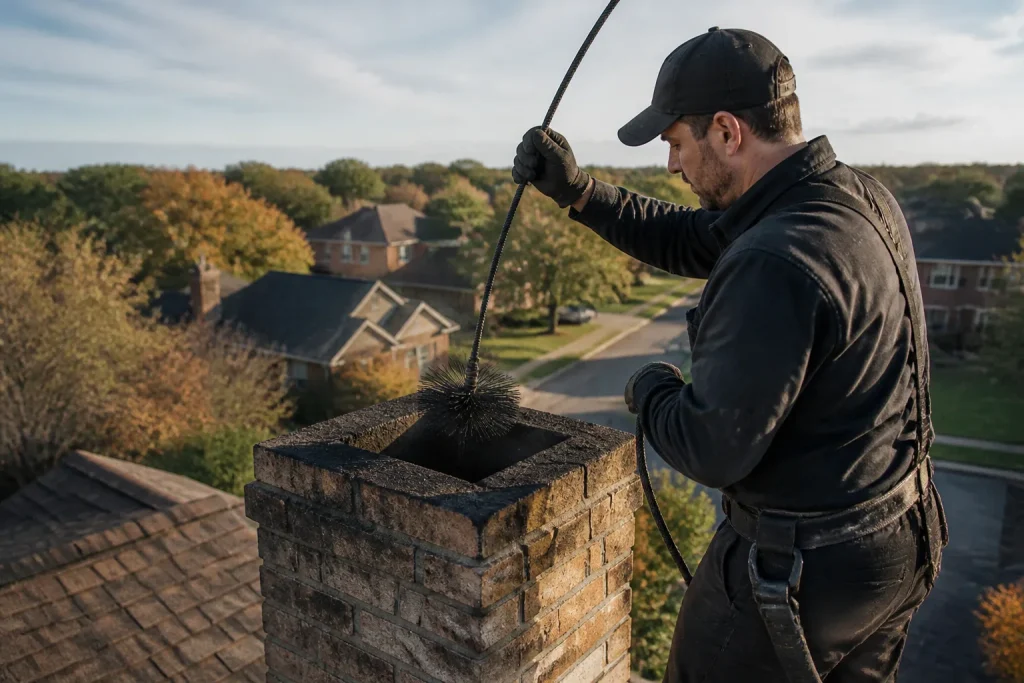
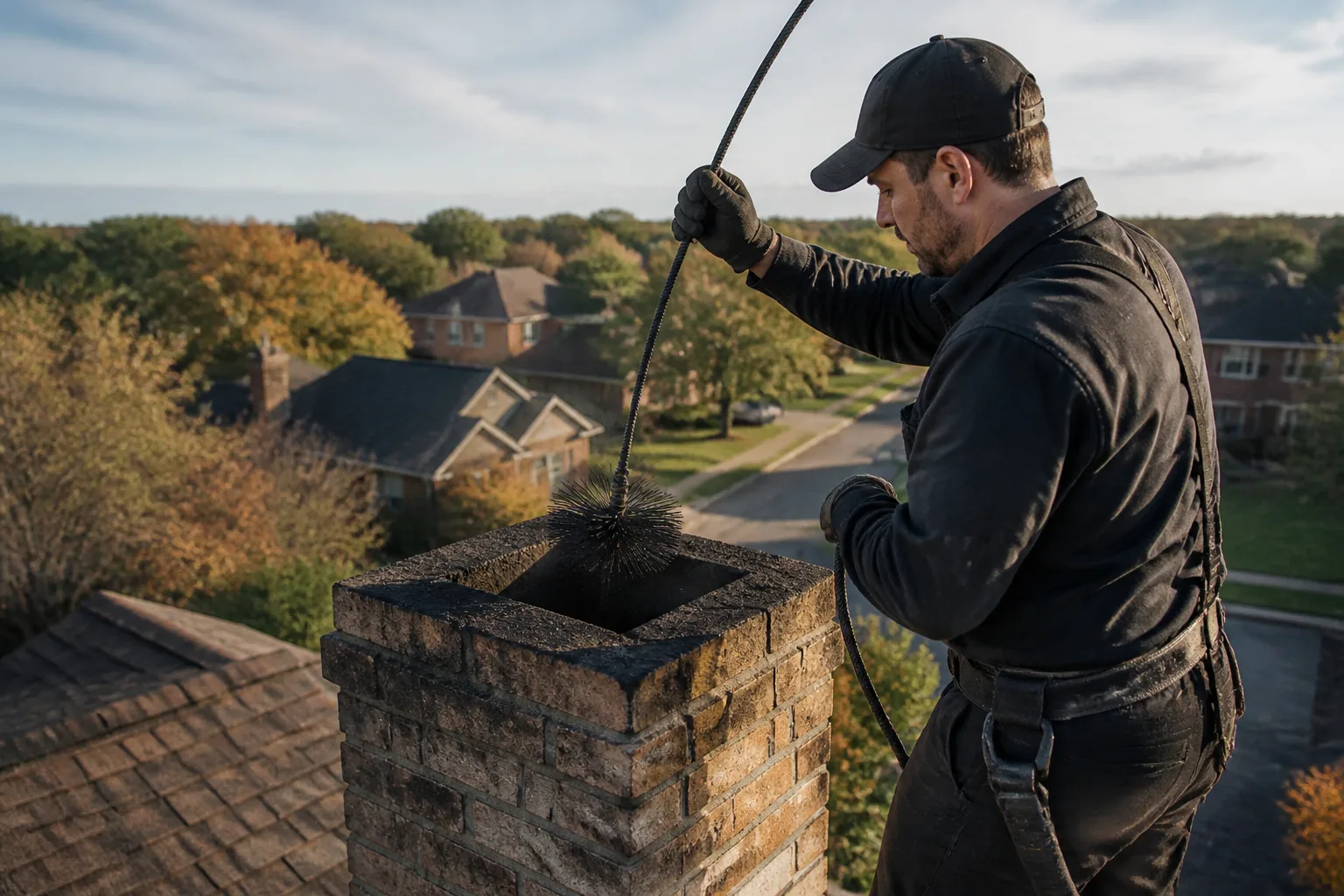
Top Signs You Need Chimney Cleaning Service – Don’t Ignore These
The clearest signs you need a chimney cleaning service are a strong campfire or sour smell in the room, soot falling onto the hearth, a flue that smokes back instead of drafting, or a visible glaze on the firebox walls. Those four alone mean the flue is carrying more creosote than it can safely hold. If you’d rather not climb up and look for yourself, call (833) 696-2226 and we’ll take a look.
Most chimney warning-sign lists online read the same. White smoke, black smoke, a smell. What they usually skip is why the symptom shows up in the first place. That gap matters, because a homeowner who understands the mechanism understands why waiting is the risky part. A campfire smell in a Meyerland living room in August, months after the last fire, isn’t a quirk of an old house. It’s the chimney telling you what’s happening to the creosote in that flue when Houston heat sits against the masonry.
So we organize the signs by what’s actually causing them, not by what they look like.
Signs That Point to Draft Problems
Draft problems show up as smoke that won’t leave. If you crack a window and the fireplace suddenly starts drawing again, you’ve just confirmed the flue isn’t pulling. That’s a draft issue, not a wood issue, and adding more kindling won’t fix it.
Common draft symptoms we hear about in Meyerland:
- Smoke rolling out of the firebox instead of up the flue
- A cold, still air pocket in the firebox before you light
- Ash and soot staining the face of the fireplace above the opening
- A noticeable downdraft when the wind shifts
- The smell of old smoke in a room with no fire lit
Draft failures are usually about restriction or geometry. A flue packed with soot has less room for air to move, and a flue that’s the wrong height for the roofline can’t build enough pressure to overcome wind. Caps matter here too. A poorly fitted cap or a blocked screen changes how air leaves the top of the chimney, and that pressure change travels all the way back down to your firebox. We work with chimney cap & crown products from Famco and Olympia Chimney for exactly this reason: the right cap restores the flow, and it keeps rain and animals where they belong.
One thing to understand: a draft problem is not the same as a dirty flue. A sweep may clear the restriction. An inspection tells you whether the flue size, cap and crown are right to begin with. Those are different answers to different questions, and it’s worth knowing which one you’re getting.
Signs That Point to Creosote Staging
Creosote builds in stages, and the stages behave differently. That’s why the same chimney can smoke fine one winter and become a genuine hazard the next.
- Soot and light dust. Brushes off easily. This is the earliest stage and the easiest to remove.
- Flaky, crunchy deposits. Creosote has started to bind to the flue walls. It’s still removable with proper sweeping.
- Glaze. A hard, shiny coating on the flue. This is the stage that matters most, because glazed creosote is dense and ignites at lower temperatures than the soft stage.
Glazed creosote is the reason a chimney fire can happen at all, and it’s the reason we don’t tell anyone to keep burning on a glazed flue until we’ve looked. You don’t need to guess at the stage. Look in the firebox and up the flue with a light: shiny black or glassy brown patches are the ones to pay attention to.
Houston humidity plays a part here. Warm, damp air moving through a flue during the off-season softens and redistributes creosote that’s already on the walls, which is one reason a strong smell can show up in a Meyerland house with no fire in months. The deposits are still there, just letting you know.
Signs That Point to Structural Deterioration
Structural problems announce themselves, but quietly. Here’s what to look at, all from the ground:
- White staining on the brick. Efflorescence is moisture moving through masonry and leaving mineral salts behind as it dries. In a humid place like Meyerland it’s more common than in drier climates, and it means water is getting in somewhere.
- Condensation inside the firebox. Damp firebox walls between burns point to moisture entering from above.
- Crumbling mortar joints. Soft, sandy mortar on the chimney exterior usually means water is penetrating the crown or brickwork.
- Cracked crown. The concrete cap on top of the chimney is the roof’s first defense. A cracked crown lets water straight into the flue.
- A rusted damper or firebox. Rust inside a firebox is never decorative. It means moisture is in constant contact with metal parts.
Water damage compounds. A small crack in a crown lets water in, water damages the liner, a damaged liner lets more heat reach the surrounding framing. Each stage makes the next one harder to fix. That’s why crowns and caps get our attention early. We install and repair crowns and caps from Gelco and Copperfield, and those products are built for a climate that stays humid most of the year.
Signs That Point to Animal Intrusion
Rattling in the flue on a windy day is not settling and it’s not your imagination. It’s one of the signs most often dismissed, and it usually means something is living up there or was recently.
Look for:
- Scratching or flapping sounds from the flue, especially in the morning
- A blocked flue that won’t draft after the first fire of the season
- Nesting material, twigs or leaves visible at the damper
- Animals on the roof near the chimney or flying to and from it
- A sour, ammonia-like odor mixed with the smoke smell
A missing or damaged cap is the usual reason birds, squirrels and bats get into a Meyerland chimney. A nest isn’t a small nuisance. It’s a blockage, and a blocked flue is a carbon monoxide risk the moment a fire is lit. This is one of the signs that means do not light a fire until someone has looked. Once the flue is clear, a proper cap from Olympia Chimney or Famco closes the gap for good.
Signs Specific to Gas Fireplaces
Wood-burning checklists miss gas fireplaces entirely, and they need their own read.
- A yellow or orange flame. A healthy gas flame burns mostly blue. Yellow or orange coloring needs attention.
- Soot on the glass or logs. Soot deposits in a gas fireplace mean the mixture is off or the venting is restricted.
- Pilot light trouble. A pilot that won’t stay lit or keeps going out points to problems with the venting or the gas flow.
- A stale or sharp smell when the fireplace runs. This is the sign to stop using it until it’s been inspected.
Gas fireplaces don’t produce creosote, so the white-smoke logic doesn’t apply. They can still be a carbon monoxide source if venting fails, so treat any gas fireplace sign seriously rather than waiting for a convenient moment. We handle fireplace repair for both wood and gas units, which means the same team that inspects gets to the fix.
Schedule Soon vs. Do Not Light a Fire
Every chimney owner eventually has to sort symptoms into two buckets. Here’s where we draw the line.
Schedule a cleaning or inspection soon:
- Light soot built up during the season
- A faint smoky smell after using the fireplace
- Efflorescence starting on the brick
- A missing spark screen or a loose cap
Do not light a fire until this has been inspected:
- Glazed or shiny creosote visible in the firebox
- Heavy soot falling into the firebox
- Smoke rolling back into the room on lighting
- A blocked flue, suspected nest or strong animal smell
- A yellow-orange flame in a gas unit
- Any sign suggesting a crack in the liner or firebox
One point we’re careful about: a sweep tells you it’s clean; an inspection tells you it’s safe. We offer inspection as its own service, so you can book one without assuming you’re going to be sold a sweep. If the flue needs a restoration rather than a patch, we use HeatShield resurfacing, a standard chimney-industry system, rather than a generic coating. High-quality liner material from DuraFlex covers the cases where replacement makes more sense. Our technicians have up to 9 years of experience working with these product lines.
As a specialist shop, we cover the full system under Chimney Sweep Meyerland including sweeping, inspection, caps, crowns and repair. If you want a straight assessment before any work is suggested, we recommend starting with an inspection.
The Bottom Line
Symptoms point to causes. Soot means restriction. Glaze means fuel on the walls. White brick means water. A rattling flue means someone else is already living up there. Once you know which part is failing, the urgency makes sense.
The symptoms that mean schedule soon are usually cheaper and quicker to deal with than the ones that mean do not light a fire. Book a sweep or an inspection before you need an emergency one. We install and service parts across the whole chimney with brands like DuraFlex, Copperfield and Olympia Chimney, so it’s one call for the full job. Call (833) 696-2226 for a free estimate. We answer 24/7, and fast dispatch from 7am to 7pm means a crew can usually be with you the same day.
Frequently Asked Questions
A smoky smell in the house, light soot on the hearth, or a firebox that doesn’t draft properly are usually the first signs. If you also see glossy black patches on the flue walls, stop using the fireplace until it’s been inspected. Call (833) 696-2226 for an inspection and a free estimate.
A sweep cleans the flue; an inspection tells you whether the flue and its parts are safe and correct. If you have any of the “do not light” symptoms above, an inspection comes first. If the signs are cosmetic, a sweep is usually enough. We offer both as separate services so you can book the one you actually need. Call (833) 696-2226 to schedule.
Creosote in the flue is volatilizing as the masonry warms and holds humidity, so old deposits release odor with no active fire. In Meyerland this is common in warm, humid weather. It’s a sign the flue needs cleaning or inspection. Call (833) 696-2226 for a free estimate.
No. Glazed creosote is the stage most associated with chimney fires, so the fireplace should stay off until it’s checked. A sweep will clear what can be removed, and a restoration with HeatShield is often the right approach for a liner that’s still sound. Call (833) 696-2226 for an inspection and a free estimate.
Written by the team at Chimney Sweep Meyerland.
Need Chimney Cleaning Help?
Call Chimney Sweep Meyerland - the local pro we connect you with is licensed and insured, with free written estimates in Meyerland.
(833) 696-2226